What Your Chronic Pain Is Trying to Tell You | Pain Science, Breathwork & Nervous System Healing
Chronic pain changes far more than the body.
Over time, it can change the way we move, the way we think, and the way we relate to ourselves. It influences our confidence, our willingness to try new things, our ability to trust our bodies, and even our sense of hope.
For many people, pain becomes more than a symptom. It becomes a constant companion that shapes daily decisions, limits possibilities, and creates an ongoing search for answers.
This is especially true when symptoms don't fit neatly into a diagnosis.
Many people living with chronic pain, nerve injuries, post-surgical complications, burnout, or persistent tension find themselves moving from practitioner to practitioner, collecting opinions that often seem to contradict one another. One provider focuses on structural issues. Another emphasizes inflammation. Someone else points toward stress, posture, muscle dysfunction, or nervous system dysregulation.
Over time, the experience can become overwhelming.
In the latest episode of Reclaim Your Body with Krista Shirley, Krista explores why this confusion matters more than most people realize—and how modern pain science, nervous system regulation, yoga philosophy, and breathwork may offer a more complete framework for understanding healing.
Pain Is Not Always About Damage
One of the most significant discoveries in modern pain science is that pain does not always directly reflect tissue damage.
While injury and structural changes certainly matter, researchers now understand that pain is heavily influenced by the nervous system's interpretation of what is happening in and around the body.
The brain is constantly gathering information from multiple sources. Physical sensations are only one piece of the puzzle.
It is also evaluating:

All of this information helps determine how protective the nervous system needs to be.
When the nervous system perceives threat, pain signals often become amplified.
This does not mean the pain is imagined. It means the nervous system is attempting to protect us.
The challenge is that sometimes the protective response continues long after tissues have healed. The nervous system can become highly vigilant, constantly scanning for danger and responding to ordinary sensations as though they require protection.
This is one reason chronic pain can persist even when imaging results improve or healing timelines suggest recovery should be complete.
The Hidden Cost of Uncertainty
One of the most compelling parts of Krista's story involves the experience of being labeled a "complex case."
Following multiple surgeries, nerve injuries, and years of rehabilitation, she encountered what many people living with chronic pain experience: conflicting explanations.
Different specialists offered different theories. Each perspective contained pieces of useful information, but no single explanation fully accounted for what she was experiencing.
While this uncertainty was frustrating emotionally, it also had important consequences neurologically.
The nervous system thrives on predictability. When the brain cannot accurately interpret what is happening inside the body, uncertainty itself can become a threat signal.
From a pain science perspective, uncertainty often increases vigilance.
The brain pays closer attention.
The body becomes more guarded.
Pain becomes louder.
Symptoms become more difficult to interpret.
This relationship between uncertainty and pain is increasingly recognized within neuroscience, yet it is rarely discussed during conventional recovery conversations.
Understanding this connection can help explain why many people feel stuck even when they are doing everything they have been told to do.
Where Yoga Philosophy and Neuroscience Meet
Although yoga and neuroscience developed in very different eras, both disciplines ask remarkably similar questions:
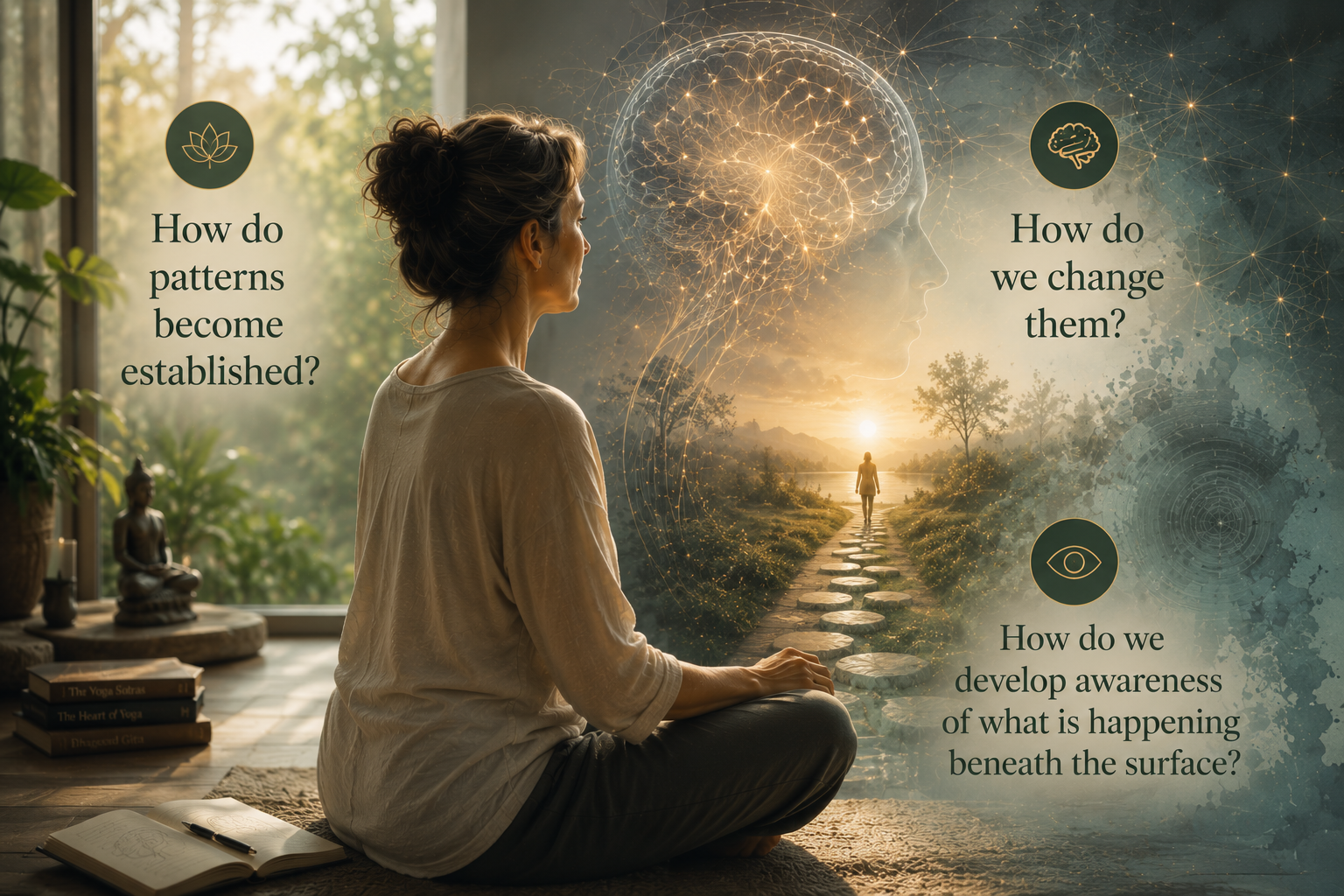
In the video, Krista explores how concepts from modern neuroscience mirror many ideas found within traditional yoga philosophy.
Current research on neuroplasticity shows that the brain is constantly adapting and reorganizing itself based on experience. The nervous system learns patterns of protection, movement, perception, and behavior over time.
Similarly, yoga philosophy speaks about samskaras—deeply ingrained patterns that influence how we perceive and respond to the world.
Both perspectives suggest something powerful:
The patterns we experience today are not necessarily permanent.
They can be observed, understood, and gradually reshaped.
This shift in perspective can be transformative for people living with chronic pain because it moves the conversation away from "What is wrong with me?" and toward a different question:
"What is my body trying to communicate?"
Breathwork, Awareness, and the Search for Safety
One of the central themes throughout Krista's work is the concept of safety.
Not simply emotional safety, but neurological safety.
When the nervous system feels safe enough, learning becomes easier. Movement becomes more accessible. Pain often becomes less dominant.
This is why breathwork plays such an important role in her teaching.
Intentional breathing influences the vagus nerve, supports nervous system regulation, and helps shift the body toward a state that is more receptive to healing.
Combined with mindful movement, body mechanics, and increased awareness, breathwork can help create the conditions necessary for meaningful change.
Healing does not always happen because we force the body harder.
Often, healing begins when the nervous system no longer feels the need to protect us quite so aggressively.
Watch the Full Video
In this deeply personal and educational conversation, Krista explores:
The neuroscience of chronic pain
Why uncertainty amplifies symptoms
How nerve injuries shaped her understanding of healing
The relationship between yoga philosophy and neuroplasticity
The role of breathwork in nervous system regulation
Why pain may be information rather than failure
🎥 Watch the full video here:
Reclaim Your Body: A New Approach to Healing
This conversation is part of a larger project currently in development.
Reclaim Your Body is an upcoming six-week online program designed to help people better understand the relationship between chronic pain, nervous system regulation, breathwork, body mechanics, mindful movement, and healing.
The program combines:
Nervous system education
Breathwork practices
Pain science
Mindful movement
Somatic awareness
Journaling
Body mechanics
Emotional regulation tools
Most importantly, it is being created for people everywhere.
Whether you're navigating chronic pain, recovering from injury, rebuilding trust in movement, or simply seeking a deeper understanding of how your body works, this program is designed to provide practical tools that can be applied from anywhere in the world.
Join the Reclaim Your Body Newsletter
If this conversation resonates with you, the best next step is to join the Reclaim Your Body newsletter.
Subscribers will receive:
Early access to the six-week program
Nervous system healing resources
Breathwork practices
Pain science education
Somatic healing tools
Course development updates
✨ Join the newsletter:
https://link.theyogashala.com/widget/form/qKNITbi8xXzVtp1iFpXa
A Different Relationship With Pain
One of the most powerful ideas explored in this video is that healing is not created through force.
It is created through relationship.
A relationship with the body.
A relationship with awareness.
A relationship with the nervous system.
For many people, chronic pain creates the feeling that the body has become the enemy. But what if the body is not working against you?
What if pain is not simply something to eliminate, but something to understand?
Sometimes healing begins when we stop fighting the body long enough to listen to what it has been trying to communicate all along.


